
24 - EV Charging – Is it an RDC or RCD?
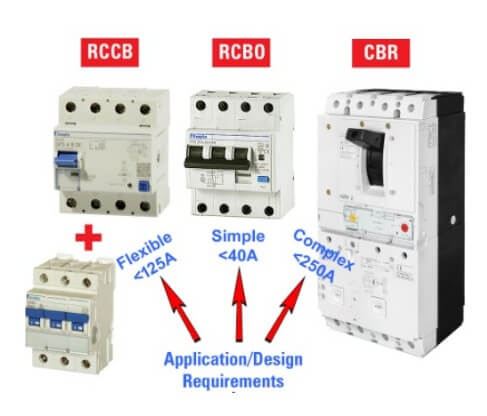
The similarity between different residual current Protection devices, the different Types, and devices that do not offer protection but detect residual currents, can trip up even some experienced contractors and installers.
Using the term RCD when ordering, without clarifying if it is an RCCB or RCBO, is the same as as ordering a timber fixing without specifying if you require a screw, nail or bolt. If you are not clear about your requirements, check with the manufacture first, to save you time at a later date.
Terminology associated with 722 Amendment 1
RCD is a generic term used in the Regulations and codes of practice to encompass RCCBs, RCBOs and CBRs. Namely devices that provide residual current “protection” i.e. they detect residual current and electrically “isolate” the circuit when the residual current exceeds a defined threshold or when the device is manually switched off. As opposed to an RCM (Residual Current Monitor) used to “detect” residual currents but does not provide residual current protection – see note to Regulation 411.1 and product standards listed at the end of clause 722.531.3.101.
722.531.3.101 recognises the following RCD formats:
RCCBs, RCBOs and CBRs provide protection through isolation of the electrical supply, in the event of a residual current fault that results in the device tripping or being manually switched off.
RCCB (EN6008-1) must be used in conjunction with a separate OLPD i.e. it must be protected against the effects of overcurrent using fuses and or MCBs.
RCBO (EN6009-1) in addition to residual current protection it also provides overcurrent protection.
RCCBs and RCBOs have fixed characteristics and in the event of a fault, are designed to be reset by ordinary persons.
CBR (EN60947-2) Circuit breaker with a built-in residual current protection feature, for use in higher current applications > 100A.
CBRs may have adjustable characteristics and in the event of a fault, are not designed to be reset by ordinary persons.
Clause 722.531.3.101 also refers to EN62423; additional design requirements for RCCBs, RCBOs and CBRs suitable for detecting Type F or B residual currents.
Clause 722.531.3.101 refers to RDC-DDs?
RDC-DD (IEC62955) stands for Residual Direct Current Detection Device*; a generic term for a range of devices designed specifically for detecting smooth DC fault currents in Mode 3 charging applications, enabling the use of Type A or F RCDs in the circuit.
* Note: If you see the term Residual Direct Current Disconnection Device or RCD-DD it is a typo. The standard for RDC-DDs IEC 62955 details two basic formats, namely RDC-MDs and RDC-PDs. Understanding the different formats will ensure that you do not purchase a product that you cannot use.
RDC-MD (Monitoring device) detects smooth DC fault currents < 6 mA and provides a signal to operate a separate switching device, either mechanically or electrically.
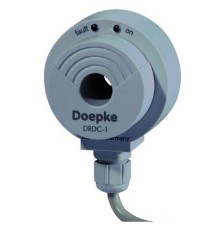
- RDC-MDs are OEM products designed for incorporation into Mode 3 chargers as part of the original design.
- The RDC -MD output signal is fed into the chargepoint software.
- RDC-MDs must be used in conjunction with a sperate RCD to provide the residual current protection.
- They are not suitable for retrofitting into old charge points.
RDC–PD (Protection Device) Incorporates 6 mA smooth DC detection and 30 mA Type A or F residual current protection in the same device, the RDC-PD contacts electrically isolate the circuit in the event of a residual current fault.
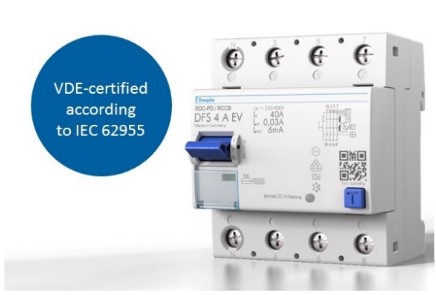
- RDC-PDs are designed for inclusion in the circuit feeding the chargepoint if the Mode 3 chargepoint does not include an RDC-MD function.
- RDC-PDs are suitable for new installations and upgrading existing installations to the latest safety requirements for EV charging.
Common questions related to RCD protection and Mode 3 charging
Why do we need to detect smooth dc fault currents > 6 mA?
- Type A RCDs are designed to function with < 6 mA smooth DC in circuit.
- If this value is exceeded the RCD cannot be relied on to provide protection.
Are Type A selective 300 mA RCCBs affected by smooth DC?
- Yes - the 6 mA limit for Type A applies irrespective of the sensitivity.
Why not use 30 mA Type B RCDs for all domestic applications?
- In simple installations containing a single chargepoint, cabling requirements may require a Type A RCD mounted upstream (in series) with the charge point – refer to the Regs.
- If you install a Type B downstream, the upstream RCD must be changed to Type B as well.
Why can’t you mount Type B RCDs downstream of Type A RCDs?
- Type B RCDs are designed to operate with higher levels of smooth DC residual current in circuit.
e.g. 30 mA Type B minimum DC trip threshold is 15 mA < 60 mA DC (0.5 to 2 x I∆n). Type A RCD exposed to > 6 mA smooth dc – see first question above.
Do manufacturers have to include RDC-DDs to IEC62955 in their Mode 3 charge points?
- No – To meet the charge point standard, the manufacturer only has to advise about the risks related to smooth DC fault currents, when using a Mode 3 charger.
- The installer is responsible for checking that equipment meets the required standards detailed in BS7671 – see 133.1 and the specific requirements of 722.
Why does BS7671 make reference to IEC62955 for RDC-DDs in Clause 722.531.3.101?
- For reasons of safety – a separate RDC mounted in a chargepoint must operate with very specific characteristics, to ensure that under all fault conditions it will interact reliably with a separately mounted RCD. Generally an RDC-MD installed in a charge point in the event of a smooth dc fault current, will provide a signal to operate a contactor*, this in turn disconnects the supply in the chargepoint.
- This prevents smooth DC flowing through the Type A RCD. However in the event of a fault that results in an AC residual current or a pulsed Type A residual current flowing in circuit, the RCD must operate before the RDC-MD*, thus ensuring that the circuit is effectively isolated – See Reg. 411.1
* Note: A Contactor cannot be used to disconnect a circuit, where the primary hazard is electrocution.
Conclusion
Check the EV Manufacturer’s information for specific RCD requirements. Check the Chargepoint specification to verify the exact features provided in that version and any additional equipment required to meet the revised requirements in BS7671.– Refer to the revised Code of Practice for EV Charging Equipment Installation 4th Edition. Equipment that fails to meet the regulations, will not provide the required level of protection. Please refer to the Doepke Web Site – Technical Publications link for additional information.
Chaz Andrews – Technical Manager, Doepke UK Ltd
SOURCE: © 2020 - 2023 Chaz Andrews. All Rights Reserved. Doepke Tec Art 24 EV charging RDC or RCDs 18th Edition Amd 1 v2 Sept 20